
How to choose a custom wood branding iron: size, handle, flame vs electric

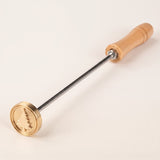
Working out how to choose a custom wood branding iron without second-guessing comes down to four criteria: the heating method suited to your workload (flame or electric), the setup (complete branding iron with a straight, bent or walnut handle, or a brass die alone or with a striking rod), the head size measured along the longest side of your logo (7 sizes from 25 to 76 mm) and material compatibility (untreated solid wood or vegetable-tanned leather, never food). This buyer's guide brings together practical benchmarks so you can compare your options objectively before ordering your flame-heated custom wood branding iron or your engraved brass die.
Flame-heated vs electric branding iron: an honest comparison
The first decision is the heat source. At Stamoro, we sell only flame-heated branding irons and brass dies (no electrical parts, supplied without a blowtorch). Before you buy, it helps to know exactly when flame heating is the smarter choice and when a temperature-controlled electric branding iron still has the edge.
| Criterion | Flame-heated iron (Stamoro models) | Electric iron 220-240 V (not sold at Stamoro) |
|---|---|---|
| Ideal batch size | One-off pieces, occasional branding and small workshop runs | Large daily production runs on flat parts at a fixed bench |
| Heat-up time | A few minutes with a butane/propane blowtorch or on a gas ring | Often 10 to 15 minutes of mains preheating |
| Consistency across batches | The head cools between marks: a brief reheat keeps the tone even | Continuous temperature held throughout the session |
| Portability and autonomy | No cord; usable in the workshop, on site or in a sheltered outdoor space | Requires a 230 V socket and power lead at a fixed workstation |
| Durability and maintenance | No heating element, lead or controller that can fail | Heating element and power cord subject to thermal wear and knocks |
| EU regulatory framework | Non-electric mechanical tool: no CE directive applies to these two models (Regulation (EC) No 765/2008, Art. 30(2)); subject to GPSR (EU) 2023/988 | 220-240 V heating appliance subject to Low Voltage Directive 2014/35/EU, standard EN 60335-2-45, RoHS and WEEE |
| Typical budget | €39.90 to €74.90 at Stamoro (brass die alone from €34.90) | Often €150 to over €300 for a compliant, regulated model |
When should you choose flame heating? If you sign furniture, boxes, crates, tool handles, turned pieces or leather goods individually or in small batches of 5 to 30 items, a brass branding iron heated with a blowtorch offers a modest budget, rapid heat-up and long mechanical life. Because it contains no electrical circuit, you also avoid the hazards of entry-level 230 V heating irons, a category regularly targeted by European recalls on EU Safety Gate for insulation defects, lack of a stable stand or fire risk.
When is an electric branding iron still preferable? If you brand hundreds of identical flat panels every day at a mains-powered bench, an electric branding iron fitted with a temperature controller and compliant with standard EN 60335-2-45 (with a stable metal stand and moulded European plug) will save time by removing reheating pauses between pieces. Likewise, if the wording changes on every item (individual names, serial numbers), laser engraving remains better suited than a fixed-motif iron (see our detailed comparison in making a DIY wood branding iron: limits and options).
Complete iron, walnut handle or brass die alone: which setup to pick
Once you have settled on flame heating, the Stamoro catalogue offers four practical configurations depending on how you work and the surface you are marking.
| Setup | Available sizes | Prices | Best suited for |
|---|---|---|---|
| Complete iron, straight handle | 5 sizes: 25, 38, 50, 63, 76 mm | €39.90 to €74.90 | Firm vertical downward pressure on open flat surfaces (boards, drawer bottoms, crates, boxes) |
| Complete iron, bent handle | 5 sizes: 25, 38, 50, 63, 76 mm | €39.90 to €74.90 | Clear sightline onto the brass head during placement, unobstructed grip on large tops and corners |
| Complete iron, walnut handle | 3 sizes: 25 mm bent, 30 mm straight, 40 mm straight | €42.90 / €43.90 / €45.90 | Dark solid walnut grip, compact and mid-range workshop formats |
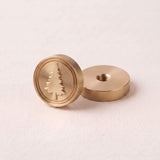
| Brass die alone or with striking rod | 5 sizes: 25, 38, 50, 63, 76 mm | €34.90 to €69.90 (die alone); €39.80 to €74.80 (with rod +€4.90) | Adding a second logo to an existing compatible handle, or cold-stamping leather with a mallet or arbor press |

Straight handle or bent handle: how to decide
The straight-handle and bent-handle models are priced identically across all five standard sizes (€39.90 to €74.90). A straight handle drives your downward force directly along the axis of the head: it works well when pressing with two hands or vertically onto a board lying flat on your bench. A bent handle offsets your hand to the side: your wrist stays in a more natural posture over a wide tabletop, and you have a direct view of the edge of the brass head as you align it with your pencil guide.
The solid walnut handle covers the most widely used formats between 25 and 40 mm: it comes in 25 mm with a bent shaft (€42.90), 30 mm with a straight shaft (€43.90) and 40 mm with a straight shaft (€45.90). Those two intermediate sizes, 30 mm and 40 mm, bridge the exact gap between a discreet 25 mm mark and a bolder 50 mm impression.
When to pick a brass die alone or with a striking rod
If you already own a compatible handle and want to order a second design (such as a secondary signature or a year stamp), buying the brass die alone (€34.90 to €69.90) saves paying for another full handle. If your main goal is cold stamping vegetable-tanned leather, select the with striking rod (+€4.90) option: it lets you strike the die with a mallet or press it in a hand press onto lightly dampened leather with no flame required. You can browse every configuration in our flame-heated branding irons and brass branding dies collections.
Which head size to choose: the 7 sizes from 25 to 76 mm
On our product pages, the selected size always refers to the longest side of your design: the diameter for a circular logo, the width for a landscape logo, or the height for a portrait logo. The other dimension scales automatically in proportion so your artwork is never distorted. Before ordering, draw a rectangle or circle of the intended size in pencil on one of your actual pieces to check how much clear margin remains around the mark.
| Size (longest side) | Straight or bent iron | Walnut handle | Die alone / with rod | Suitable items and logos |
|---|---|---|---|---|
| 25 mm (1") | €39.90 | €42.90 (bent shaft) | €34.90 / €39.80 | Initials, simple monogram, small icon on leather cardholders, tool handles, turned items |
| 30 mm | not offered | €43.90 (straight shaft) | not offered | Compact signature (icon + short word) on small boxes, coasters, small leather goods |
| 38 mm (1.5") | €47.90 | not offered | €42.90 / €47.80 | All-round workshop size: presentation boxes, small furniture pieces, leather wallets and belts |
| 40 mm | not offered | €45.90 (straight shaft) | not offered | Balanced round or square logo on wood and leather, crisp legibility for a full workshop name |
| 50 mm (2") | €54.90 | not offered | €49.90 / €54.80 | Most popular cabinetmaking size: drawers, trays, boxes and bags; indicative upper limit for a butane torch |
| 63 mm (2.5") | €64.90 | not offered | €59.90 / €64.80 | Detailed logo (emblem + two lines of text) on furniture, large crates or panels; propane torch recommended |
| 76 mm (3") | €74.90 | not offered | €69.90 / €74.80 | Large mark visible from a distance on crates, furniture, workshop panels; needs a very flat surface and a propane torch |

Two sizing mistakes that are easy to avoid: picking 25 mm for a text-heavy logo (letters quickly drop below 2 mm and blur together when heated), or choosing 76 mm for a slightly curved item or timber with uneven grain (the wider the contact area, the more critical surface flatness and even heating become). As an indicative benchmark, a British manufacturer's guide on flame-heated branding irons notes that a butane blowtorch is sufficient up to roughly 50 mm wide and recommends a propane torch beyond that.
Wood, leather and regulatory limits: what you can brand
Our heads are relief-engraved in solid brass. According to the physical constants compiled by Engineering ToolBox, yellow brass (70% copper, 30% zinc) has a thermal conductivity of 111 W/(m·K) at 20 °C, compared with 54 W/(m·K) for carbon steel (0.5% C) and 14.4 W/(m·K) for 304 stainless steel. That high heat transfer helps distribute temperature evenly right across the engraved design.
Untreated solid wood
All our branding irons and brass dies suit raw, sanded solid wood with no prior finish (oil, wax or varnish should always be applied after branding):
- Fine-grained soft hardwoods (lime, birch, poplar, alder): take colour quickly with even contrast, making them easy to dial in from your first test marks.
- Dense hardwoods (beech, oak, maple, walnut, ash): yield a crisp, lasting mark, requiring slightly higher heat or a fraction of a second longer contact on denser grain.
- Softwoods (pine, fir, spruce): usable on knot-free areas, using moderate heat tested on an offcut first so resin does not bleed out.
Conversely, never brand pressure-treated timber, chemically treated pallets, painted or varnished wood, or glued sheet materials (MDF, chipboard, plywood). The UK body HETAS warns that these materials release toxic fumes when heated, and the French occupational safety institute INRS notes that formaldehyde from board adhesives is classified as carcinogenic and mutagenic (work subject to CMR regulations in France since 2007). When sanding beforehand, use dust extraction or a suitable respirator: wood dust is classified as carcinogenic by INRS (occupational exposure limit in France of 1 mg/m³ over 8 hours). To master the technique step by step, read our guide on how to use a wood branding iron.
Vegetable-tanned leather (hot or cold)
Vegetable-tanned leather responds very well to both methods: either hot using the complete branding iron heated far more gently than for timber (gradual testing on a scrap piece is essential so you do not scorch the grain), or cold on lightly dampened leather using the brass die fitted to a striking rod with a mallet or hand press for a clean debossed mark without any flame. Avoid hot branding on synthetic or heavily coated leathers, whose surface layer can melt or emit fumes.

Essential regulatory and safety limits:
- Never for food contact: materials intended to touch food fall under Regulation (EC) No 1935/2004 (certified alloys and dedicated compliance testing). Our brass heads are strictly reserved for wood and leather.
- Flame and heat safety: work in a clear, well-ventilated area away from wood shavings, paper (auto-ignition between 218 and 246 °C according to Engineering ToolBox) and solvents (INRS ED 6030, HSE INDG297). Wear heat-resistant gloves and eye protection, stop heating before the brass turns red (melting point 905 to 932 °C according to Engineering ToolBox), rest the hot tool on a non-combustible surface and let it cool completely in air without ever quenching it in cold water.
Preparing your logo, ordering and planning lead times
Even the right branding iron cannot save artwork that is too fine or built in greyscale. In thermal branding, only the raised metal face chars the wood: your file must be in pure black and white, with no shadows or tonal gradients. As workshop rules of thumb from manufacturers, aim for line widths of at least 0.5 mm, gaps of at least 0.5 to 1.19 mm between adjacent elements and letter heights of at least 2 mm (full details in our guide patterns and preparing a crisp branding logo and our Logo preparation guide).
How ordering works on the product page
- Select your model, size and setup: complete branding iron (straight, bent or walnut handle) or brass die alone / with striking rod.
- Upload your file or enter your text: our product pages accept
SVG,PDF,PNGandJPGfiles (10 MB max, minimum 300 dpi advised for raster images, 600 dpi recommended by some makers for fine lines) or direct text (up to 3 lines of 24 characters, 3 styles). Always upload your logo the right way round: we automatically mirror-engrave it so the finished impression reads properly on your piece. - Check the preview before adding to your basket: the page displays an indicative visual preview to scale with a ruler in centimetres for
SVG,PNG,JPGimage formats and text mode (with a warning below 2 mm letter height in text mode only).PDFfiles are attached to the order without a visual preview. - Proofread carefully before confirming: engraving begins directly from the file or text submitted, without a prior digital proof. Under French law (Code de la consommation, Art. L221-28, 3°), goods made to the consumer's specifications are excluded from the right of withdrawal. If you are unsure whether fine details in your logo will hold up before ordering, contact us via our Contact page (contact@stamoro.com).
Actual lead times, delivery to 38 countries and guarantee
Every brass head is custom-engraved in 2 to 3 days, then dispatched with tracking towards 38 countries: 27 European Union countries in 8 to 15 days (10 to 18 days total including engraving: free delivery to 9 countries: France, Germany, Belgium, Austria, Spain, Italy, the Netherlands, Poland and Portugal, and a flat rate of €4.90 to €11.90 elsewhere in the EU) and 11 non-EU countries at a fixed rate in 4 to 15 days depending on destination (full table in our shipping policy). Every piece is covered by the 2-year EU/French legal guarantee of conformity, without affecting mandatory local statutory rights: if the delivered engraving does not match the file or text confirmed at checkout, we remake and reship it free of charge.
Ready to customise your wood branding iron?
Choose your size (25 to 76 mm), pick your setup (straight, bent or walnut handle, or brass die alone) and check the scale of your logo directly on the product page.
Browse all custom wood branding irons, or read next: how to use a wood branding iron, preparing a crisp logo and DIY branding iron: limits.
Frequently asked questions
Should I choose a flame-heated branding iron or an electric one?
For signing one-off pieces, gifts or small workshop runs, a flame-heated brass branding iron is more affordable, heats up in a few minutes, needs no mains socket and has no electrical element that can wear out. A regulated electric branding iron compliant with EN 60335-2-45 makes most sense if you mark large daily batches of flat panels at a fixed bench. Stamoro sells flame-heated models and brass dies exclusively.
What head size should I choose for a logo with text on wood?
For a simple monogram or initials, 25 mm or 30 mm is plenty. As soon as your logo combines an emblem with a workshop name, 38 mm, 40 mm or 50 mm keeps letters at least 2 mm tall so they do not clog when heated. The 63 mm and 76 mm formats are best kept for large flat surfaces using a propane torch. The chosen size always corresponds to the longest side of your design.
What is the difference between a straight handle, bent handle and walnut handle?
The straight handle suits firm vertical pressing on flat boards or drawer bottoms; the bent handle offsets your hand to the side so you can clearly see the edges of the brass head as you position it (both cost €39.90 to €74.90 depending on size). The dark solid walnut handle comes in three sought-after sizes: 25 mm with a bent shaft (€42.90), 30 mm with a straight shaft (€43.90) and 40 mm with a straight shaft (€45.90).
When should I order the brass die alone or with a striking rod?
The brass die alone (€34.90 to €69.90 in 5 sizes from 25 to 76 mm) lets you add a new design to a compatible handle you already own. The option with a striking rod (+€4.90, i.e. €39.80 to €74.80) is ideal if you want to cold-stamp lightly dampened vegetable-tanned leather with a mallet or hand press without heating the head.
Can the same brass branding iron be used on wood, leather and food?
No. An engraved Stamoro brass branding iron is intended solely for untreated solid wood and vegetable-tanned leather. It must never come into contact with food, because food-contact articles are governed by Regulation (EC) No 1935/2004, which requires certified materials and dedicated compliance testing.
What lead time should I expect and do I see a preview before engraving?
Allow 2 to 3 days for engraving plus 8 to 15 days for tracked delivery across 27 EU countries (4 to 15 days to 11 non-EU countries, 38 countries in total). Before adding to your basket, the product page shows an indicative visual preview to scale for SVG, PNG and JPG images as well as text mode (with an under-2 mm alert in text mode only; PDF files are attached without a visual preview). Engraving proceeds without a prior digital proof and is covered by the 2-year EU/French legal guarantee of conformity, without affecting mandatory local statutory rights, including a free remake if the engraving does not match your confirmed file.
What is the best branding iron for wood?
For custom furniture, wooden boxes, workshop tools, and small batches, a flame-heated CNC-engraved brass iron offers fast heating, cordless freedom, and high durability from €39.90. Reserve a regulated electric branding iron complying with EN 60335-2-45 for high-volume daily stamping of flat boards at a fixed station.
How do you stamp leather with a brass stamp without a machine?
Order our custom brass die with the optional steel striking rod (+€4.90, 18 mm diameter, 82 mm length), lightly dampen vegetable-tanned leather on a firm bench, and strike squarely with a mallet. It delivers a sharp blind impression with no heat or press.
Sources
Engineering ToolBox (thermal conductivity of metals), Engineering ToolBox (melting points) and Engineering ToolBox (auto-ignition temperatures): reference physical data for yellow brass (111 W/(m·K), melting point 905 to 932 °C), steel (54 W/(m·K)), 304 stainless steel (14.4 W/(m·K)), paper and wood. INRS wood dust (carcinogenic, occupational exposure limit in France 1 mg/m³ over 8 h), INRS formaldehyde (carcinogenic and mutagenic, CMR rules in France since 2007), INRS ED 6030, HSE (guide INDG297) and HETAS: fire safety, gas, wood dust and treated or glued woods to avoid. European and French regulations: Low Voltage Directive 2014/35/EU and standard EN 60335-2-45 (portable electric heating tools), Regulation (EC) No 1935/2004 (food contact), Regulation (EC) No 765/2008 Art. 30(2) (CE marking), Regulation (EU) 2023/988 (GPSR) and French Code de la consommation Art. L221-28, 3° (goods made to consumer specifications). The 7 sizes (25 to 76 mm, including walnut handle in 25, 30 and 40 mm), prices, configurator features, lead times and delivery to 38 countries come from the live Stamoro catalogue verified on 25 November 2026. General graphic benchmarks (lines >= 0.5 mm, spacing 0.5 to 1.19 mm, letters >= 2 mm, indicative butane/propane threshold around 50 mm, 600 dpi for fine lines) come from technical guides published by European and North American workshops archived in our internal dossier (23 and 25 November 2026) and serve as general rules of thumb rather than measured specifications of Stamoro products.