
DIY Wood Branding Iron: Material Limits, Safety & Options

To burn your logo safely into wood, the part you can genuinely do yourself is drawing your black-and-white artwork and dialling in the impression on an offcut. Making a DIY wood branding iron metal head yourself quickly runs into three obstacles: tin solder melts from 215 °C, the face rarely sits flat, and modifying a 230 V electric tool creates a real risk of electric shock and fire.
DIY branding: the artwork yes, the metal head rarely
As one branding stamp manufacturer sums it up, the phrase "making a DIY wood branding iron" covers two very different tasks. Designing your own artwork (monogram, initials, clean black-and-white logo) costs nothing and directly improves the final mark. Machining a branding head capable of withstanding high heat and leaving a crisp mark, however, is precision metalwork.
Online, the homemade builds that actually work rely on full workshop machines: a metal lathe and a milling machine to cut a solid block, or CNC engraving. With twisted wire, a nail or a folded piece of sheet metal, you can at best press a very basic geometric mark onto a rustic board, not a legible logo or workshop name.
Physical limits of homemade branding irons
According to that same technical guide, four flaws recur on heads made without proper machining: relief that is too shallow so the backing plate scorches the wood, an uneven face, poor heat distribution and a handle that becomes dangerously hot. The physical properties of metals published by Engineering ToolBox explain these failures directly.
Soft tin solders fail before the wood even brands: 50/50 tin-lead solder melts at 215 °C and pure tin at 232 °C, whereas the auto-ignition temperature of wood sits around 300 °C (427 °C for dry pine, 482 °C for dry oak according to Engineering ToolBox). Any assembly joined with soft solder comes apart in the flame or against the wood.
Zinc and galvanised fasteners or sheet metal do not stand up to an open flame either: zinc melts at 419.5 °C, degrading the coating on galvanised bolts or plates.
Copper, on the other hand, conducts heat far too quickly toward your hand. According to Engineering ToolBox, its thermal conductivity reaches 401 W/(m·K), almost four times that of yellow brass (111 W/(m·K)) and nearly twenty-eight times that of 304 stainless steel (14.4 W/(m·K)).
| Metal or alloy | Thermal conductivity (W/(m·K)) | Melting point (°C) | Effect on a branding iron |
|---|---|---|---|
| 50/50 solder (tin-lead) | Not compared | 215 °C | Melts well below the temperature of a flame-heated head |
| Zinc (galvanised coating) | Not compared | 419.5 °C | Degrades in a flame, should be avoided |
| Copper | 401 (at 0 °C) | 1,084 °C (copper ref.) | Very conductive: sends heat rapidly back toward the hand |
| Yellow brass (70% Cu, 30% Zn) | 111 (at 20 °C) | 905 to 932 °C | Good balance of CNC machinability and even heat across the face |
| Carbon steel (0.5% C) | 54 (at 20 °C) | 1,425 to 1,540 °C | Spreads heat less evenly across a wide face |
| 304 stainless steel | 14.4 (at 20 °C) | 1,510 °C | Limits heat conduction effectively along a shaft |
For wood, branding iron makers frequently use an engraved brass head, which machines cleanly (for instance with a 3 to 4 mm relief depth on brass dies at one European manufacturer to prevent background marks); some makers also offer steel, which resists wear even better.
Dangerous mistakes to avoid: 230 V power, gas and fumes
Never modify a soldering iron or any 230 V heating appliance to attach a homemade head. In Europe, portable electric heating tools fall under the Low Voltage Directive 2014/35/EU and harmonised standard EN 60335-2-45 (insulation, creepage distances, handle temperature rise, stable stand). Poorly insulated heating devices regularly appear in recalls on the European EU Safety Gate portal for electric shock, melting handles or fire risk. Repurposing a soldering iron destroys its safety margins.
Likewise, do not improvise arc welding, gas brazing or thermal cutting without proper training and equipment. If you heat a flame-ready branding iron with a butane or propane torch, keep in mind the fire triangle noted by INRS: a fuel (wood, shavings, paper; Engineering ToolBox places paper auto-ignition between 218 and 246 °C and wood around 300 °C), air and an ignition source are all it takes to start a fire. Publication INRS ED 6030 notes that hot work accounts for over 30% of workplace fires and that heat can continue spreading through radiation, conduction or smouldering after work stops.

Mandatory safety precautions for all flame-heated branding (INRS and HSE):
- Always follow your gas torch manual; check fittings before lighting and test for leaks only with a suitable leak-detection product, never with a naked flame (HSE, guide INDG297).
- Wear heat-resistant gloves and safety glasses, and clamp or wedge the workpiece instead of holding it by hand (HSE INDG297).
- Heat only the metal head, never the wooden handle.
- Work in a clear, well-ventilated space with no sawdust, paper, rags or solvents nearby, and keep a suitable fire extinguisher within reach (HSE INDG297, INRS ED 6030). Never apply a flame to any drum or container that may have held a flammable substance, even when empty.
- Switch off the torch as soon as you stop using it: never put a lit torch down on a bench or on the floor, as the force of the flame can make it move (HSE INDG297). Close the gas valve after use and store the cartridge or cylinder in a well-ventilated place, never in a confined space.
- Always rest the hot iron on a non-combustible surface (brick, metal or stone), never leave it unattended, and check that no hot surface or smouldering ember remains once finished (INRS ED 6030).
- Keep the branding iron and heat source out of the reach of children.
- Let the head cool completely in open air before handling or storing it; never plunge hot metal into cold water (steam bursts and warping).
- Brand only raw solid wood, sanded with dust extraction or a mask (wood dust is classified as carcinogenic by INRS, occupational limit value in France of 1 mg/m³ over 8 hours). Rule out pressure-treated timber, treated pallets, painted or varnished wood and glued MDF or chipboard panels (HETAS; carcinogenic and mutagenic formaldehyde subject in France to CMR rules since 2007 according to INRS).
- A branding iron made for wood and leather must never come into contact with food (Regulation (EC) No 1935/2004).
4 ways to burn your logo into wood
If your goal is to sign wooden work cleanly, four options exist, each with very different trade-offs.
| Method | Logo sharpness | Batch speed | Main limitations |
|---|---|---|---|
| Homemade DIY (wire, nail, sheet metal) | Very limited (crude shape) | Slow, constant reheating | Uneven face, low thermal mass, burn and solder failure risks |
| Manual pyrography pen | Good depending on skill | Slow (several minutes per piece) | Each mark varies slightly |
| CNC laser engraving | Very precise, even on intricate logos | Fast on flat parts | Requires a dedicated machine or outsourced batch runs (not portable for assembled furniture) |
| Custom flame-heated branding iron | Crisp with simplified logo (lines ≥ 0.5 mm) | 3 to 5 s contact after heating | Needs reheating for large runs, torch not included, fixed design |
As laser engraving workshops demonstrate, a laser remains unbeatable for fine graphics on flat panels in volume. A flame-heated branding iron wins out as soon as you want to sign pieces directly in your own workshop, including assembled furniture, without outsourcing every run or investing in heavy electrical equipment.
Switching to a custom engraved flame-heated branding iron
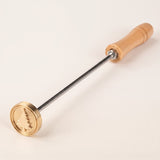
To get repeatable marks without modifying an electric tool or buying a CNC machine, the simplest route is to prepare your black-and-white logo yourself and order a custom engraved brass head. At Stamoro, we offer two non-electric models supplied without a torch and dedicated exclusively to wood and leather (no CE marking, as no CE directive applies to these non-electric tools):
- Custom flame-heated branding iron for wood and leather: seven sizes measured on the longest side of the design, with a straight or bent handle in 25 mm (€39.90), 38 mm (€47.90), 50 mm (€54.90), 63 mm (€64.90) and 76 mm (€74.90), or a walnut handle in 25 mm bent (€42.90), 30 mm straight (€43.90) and 40 mm straight (€45.90).
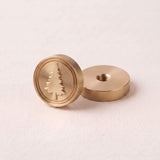
- Custom brass die for wood and leather: engraved head on its own in five sizes from 25 to 76 mm (€34.90 to €69.90) or with an optional striking rod for leather (€39.80 to €74.80).

On each product page, upload your file (SVG, PDF, PNG or JPG, 10 MB max) or type your text with an indicative scale preview (available for SVG, PNG and JPG image formats and text mode, with a letter-height alert below 2 mm applying in text mode only; PDF files are attached without a visual preview). Engraving runs directly from the confirmed file or text, with no prior digital proof (custom-made item exempt from the right of withdrawal under French Consumer Code art. L221-28, 3°). Allow 2 to 3 days for engraving, followed by tracked delivery to 38 countries (27 European Union countries in 8 to 15 days, free in 9 countries: France, Germany, Belgium, Austria, Spain, Italy, the Netherlands, Poland and Portugal, and a flat rate of €4.90 to €11.90 elsewhere in the EU; 11 non-EU countries at a flat rate in 4 to 15 days depending on destination, see our shipping policy). Two-year legal guarantee of conformity and free remake if the engraving does not match the approved file. Have a question before ordering? Check our logo preparation guide or our Contact page.
Want a crisp logo without modifying a heating tool?
Draw your black-and-white artwork, and we engrave the brass head in 2 to 3 days (sizes from 25 to 76 mm, straight, bent or walnut handle).
See also: pyrography patterns and preparing a crisp logo, how to use a wood branding iron and all branding irons.
Frequently asked questions
Can you make a wood branding iron using tin solder?
No. According to Engineering ToolBox, 50/50 tin-lead solder melts at 215 °C and pure tin at 232 °C, far below the several hundred degrees reached by a flame-heated head. The joint comes apart quickly when heated.
Is it safe to convert an electric soldering iron into a branding iron?
No, it is strongly advised against. A 230 V heating appliance is governed by strict insulation and thermal-resistance standards (Directive 2014/35/EU, standard EN 60335-2-45). Modifying it creates serious risks of electric shock, handle meltdown and fire.
Why is brass often used instead of solid copper or galvanised sheet metal?
Yellow brass (111 W/(m·K), melting point 905 to 932 °C) engraves cleanly and distributes heat well across the logo face. Copper conducts heat nearly four times faster (401 W/(m·K)) and sends it quickly back toward your hand, while the zinc coating on galvanised parts melts from 419.5 °C.
Should I choose laser engraving or a branding iron for a logo on wood?
Laser engraving suits highly detailed designs on flat pieces handled by a machine or workshop service. A flame-heated branding iron suits clean logos with lines of at least 0.5 mm that you want to stamp yourself in the workshop, including on assembled items.
Can a wood branding iron be used in contact with food?
No. Branding food requires materials certified for food contact (Regulation (EC) No 1935/2004). An iron designed for wood and leather must never be used on food.
Can I make a DIY branding iron for wood at home?
You can easily create your own black-and-white artwork at home, but fabricating a flat, deep-engraved metal head without CNC machining rarely produces a clean logo. Soft 50/50 solder melts at 215 °C, galvanized zinc degrades at 419.5 °C, and modifying a 230 V soldering iron poses serious electrical and fire risks.
How to brand wood without a branding iron?
Without a custom branding iron, you can trace a design and burn it freehand with a dedicated pyrography pen for one-off art, or send flat panels out for CNC laser engraving. Once you want to sign multiple boxes, boards, or assembled furniture quickly in your own shop, a flame-heated brass iron becomes the simplest option.
Sources
Engineering ToolBox (melting points), Engineering ToolBox (thermal conductivity) and Engineering ToolBox (auto-ignition): reference physical data on 50/50 solder, tin, zinc, copper, brass, steel, stainless steel, paper and wood. HSE (guide INDG297): safe use of gas torches and fuel gases (leaks, ventilation, shutting off valves, clamped workpieces, fire extinguisher, flammable containers). INRS ED 6030 (Le permis de feu), INRS fire, INRS wood dust, INRS formaldehyde and HETAS: hot work, fire risks, dust, treated wood and carcinogenic, mutagenic formaldehyde (CMR rules in France). Regulations on electrical safety (Directive 2014/35/EU, EN 60335-2-45), food contact (Regulation (EC) No 1935/2004), CE marking (Regulation (EC) No 765/2008 art. 30(2)) and custom-made goods (French Consumer Code art. L221-28, 3°). The 7 sizes (25 to 76 mm, including walnut handle in 25, 30 and 40 mm), prices, lead times and shipping to 38 countries match the Stamoro catalogue verified on 25 November 2026. Workshop findings on DIY limitations, brass/steel heads, 3 to 4 mm relief depth and laser engraving come from European and North American manufacturers' technical guides archived in our internal file on 23 November 2026; they are general guidelines and not product-specific tests on Stamoro items.