
How to Use a Wood Branding Iron: A Complete Guide

To brand wood successfully, first choose the right tool for your project: a pyrography pen suits one-off drawings and freehand shading, while an engraved branding iron lets you stamp the same logo in a few seconds of contact (a 3 to 5 s guideline to adjust on a scrap piece) on many pieces. Always work on raw, dry, sanded wood, after two or three test marks on an identical offcut.
Pyrography pen or branding iron: how to choose?
Burning marks into wood covers two very different practices. The choice depends mainly on how often the design repeats and on the look you want.
A pyrography pen heats a fine tip so you can draw line by line. It is used to illustrate, shade or write a one-off dedication. Reproducing an identical logo on twenty boxes or cases quickly becomes slow and uneven when done freehand.
A branding iron carries an engraved metal block with a reversed relief, often made of brass for wood. According to the physical measurements compiled by Engineering ToolBox, yellow brass (70% copper, 30% zinc) has a thermal conductivity of 111 W/(m·K) at 20 °C, compared with 54 W/(m·K) for 0.5% carbon steel and 14.4 W/(m·K) for 304 stainless steel. In principle, this higher conductivity helps the heat spread across the head.

| Criterion | Pyrography pen | Flame-heated branding iron |
|---|---|---|
| Main use | Freehand drawing, portraits, one-off text, gradients | Repeated logo, monogram or signature |
| Time per piece | Several minutes to several hours | A few seconds of contact after heating |
| Consistency across a series | Varies with the hand | Identical design, consistent result if heating and pressure are steady |
| Heat source | Mains power or regulated station | Butane/propane torch or gas burner |
| Main limitation | Slow for signing a series | Fixed design, limited fine lines |
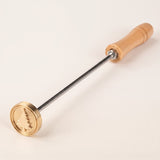
Compared with an electric model, a flame-heated iron is simple to use, with no cable or electric heating element, and is well suited to occasional branding, one-off pieces and small batches. To sign your wood or leather pieces without a cable, take a look at our custom flame-heated wood branding iron (from €39.90).
Which wood species to choose or avoid?
Not all wood species react to heat in the same way. The auto-ignition reference values published by Engineering ToolBox illustrate these differences between woods: 300 °C as a generic value for wood, 427 °C for dry pine and 482 °C for dry oak. These are physical reference quantities in air, not tool settings.
Light, soft hardwoods: the easiest to start with
Pyrography workshops primarily recommend lime (basswood), birch, poplar and alder. Their fine grain, light colour and lack of resin give a clear contrast without the tip skipping.
Dense hardwoods: oak, beech, walnut, ash
These dense woods give lasting marks with a branding iron, but they absorb more thermal energy. A specialist Czech guide states that for pyrography on hornbeam, beech or oak, a station of at least 40 W is useful. With a branding iron, manufacturers' guides point out that you need a fully heated head and sometimes a slightly longer contact time than on a softwood.
Softwoods (pine, spruce, fir): something to know
Some general-audience guides recommend pine for beginners because it is soft and inexpensive. In practice, pyrography workshops and iron makers highlight two concrete difficulties: resin pockets can run and leave black halos, while the alternation of soft and hard growth rings creates an uneven mark. If you have to brand pine, choose a knot-free area and adjust the heating through tests on an offcut.
Woods to rule out for your health
Never burn pressure-treated wood, treated pallets, painted or varnished wood, or chipboard or MDF panels. The British body HETAS points out that treated, painted or varnished wood and glued boards give off toxic fumes when they burn; as a precaution, do not brand them. For its part, France's INRS (national occupational health and safety institute) states that the formaldehyde used in the resins of reconstituted panels is acutely toxic and carcinogenic and mutagenic (work subject in France to CMR rules since 2007). Brand only solid, raw wood with no prior finish.
Branding wood with a flame-heated iron, step by step
The guidelines below come from instructions and guides by European and North American manufacturers. They do not replace the instructions for your own tool, nor tests on an offcut of your wood.
- Sand the area flat to get a smooth surface and remove all sawdust. INRS points out that wood dust is classified as carcinogenic (occupational limit value in France of 1 mg/m³ over 8 hours): sand in a ventilated space, with extraction and a suitable mask.
- Check that the metal head is firmly attached to its shaft and does not move before heating.
- Optionally, spray a very light water mist on the area to be branded. Several manufacturers' guides use this trick on raw wood to slow the sideways spread of heat and limit the burnt halo. Test with and without water on an offcut to see what suits your species.
- Heat only the metal head with a butane or propane torch or a gas burner, never the wooden handle. As a guideline, a British guide to flame-heated irons says that a butane torch is enough up to about 50 mm in width and recommends a propane torch beyond that. Move the flame regularly over the head and stop before the metal glows red: according to Engineering ToolBox, yellow brass melts between 905 and 932 °C, and overheating can deform fine details.
- Make two or three tests on an offcut of the same wood, as iron manufacturers recommend. Heating time depends on the size of the head and on the flame: only a test on an offcut confirms that the iron is ready.
- Set the iron square on your piece without rocking it, and hold steady pressure. A US tooling guide gives a guideline of 3 to 5 seconds, and a British manufacturer advises not to exceed 5 seconds so that details do not blur. Lift the iron straight up.
- Let the piece cool completely before applying your finish (oil, wax or varnish).

| Observed defect | Likely cause | Fix on an offcut |
|---|---|---|
| Pale or incomplete mark | Iron not hot enough or contact too brief | Heat a little longer or press slightly longer, without exceeding 5 seconds |
| Black halo, clogged letters | Iron too hot or contact too long | Let it cool for a few seconds, shorten the contact time, try a water mist |
| One edge marked and the other missing | Iron set at an angle or wood not flat | Check flatness, set the iron down flat with vertical pressure |
| Sticky black stains | Resinous wood (pine, fir) or existing finish | Move away from knots, work on raw untreated wood |
Fire safety, burns and brass care
Working with an open flame and very hot metal near wood shavings calls for a careful routine. As INRS points out, a fire starts as soon as three elements meet: a fuel (wood, sawdust, paper; Engineering ToolBox puts the auto-ignition of paper between 218 and 246 °C and that of wood at around 300 °C), air, and an ignition source such as an open flame or a hot surface.
Safety precautions before and after each session:
- Wear heat-resistant gloves and safety glasses.
- Heat only the metal head, never the wooden handle; keep your hand away from the metal shaft, which conducts heat.
- Work in a clear, well-ventilated area, with no sawdust, solvent, rags or cardboard nearby.
- Always set the hot iron on a non-combustible surface (brick, metal or stone) and never leave it unattended.
- Keep the tool and the flame source out of the reach of children.
- Let it cool completely in open air before touching, unscrewing or storing the head. Never dip a hot iron in cold water: the thermal shock causes bursts of scalding steam and can deform the metal.
- Use an iron intended for wood and leather only on those materials, never in contact with food, which is covered by separate health regulations (Regulation (EC) No 1935/2004).
For care, a manufacturer's guide recommends removing carbonised residue with a soft wire brush, then drying the tool and storing it in a dry place. As a cooling guideline, a pyrography tool guide says to wait 20 to 30 minutes before cleaning a tool; for a more massive metal head, always check from a distance that it is completely cold. The colour change of brass after heating is normal, as our product pages indicate, and does not affect the marking. A manufacturer's guide also advises storing the tool dry with a very thin film of mineral oil on the cold metal; wipe off any excess before the next heating.
Choosing your custom branding iron at Stamoro
As soon as you make several wooden objects (boxes, cases, furniture, tool handles or workshop gifts) and want a consistent signature, an engraved branding iron is a better option than drawing with a pen. Our shop offers two models dedicated exclusively to wood and leather, with no electrical circuit and delivered without a torch. These two non-electric models do not carry a CE marking, as no CE directive applies to these products.
- Custom flame-heated branding iron for wood and leather: brass head engraved to your logo or text, with a straight or bent handle at the same price. Five sizes available (measured on the longest side of the design): 25 mm (1") at €39.90, 38 mm (1.5") at €47.90, 50 mm (2") at €54.90, 63 mm (2.5") at €64.90 and 76 mm (3") at €74.90.
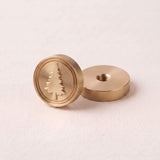
- Custom hot stamp, brass die for wood and leather: custom-engraved head from 25 to 76 mm to fit a compatible handle or press, offered on its own (from €34.90 to €69.90) or with a striking rod for vegetable-tanned leather (from €39.80 to €74.80).

| Size | Complete flame-heated iron (straight or bent) | Die only | Die with striking rod |
|---|---|---|---|
| 25 mm (1") | €39.90 | €34.90 | €39.80 |
| 38 mm (1.5") | €47.90 | €42.90 | €47.80 |
| 50 mm (2") | €54.90 | €49.90 | €54.80 |
| 63 mm (2.5") | €64.90 | €59.90 | €64.80 |
| 76 mm (3") | €74.90 | €69.90 | €74.80 |
Directly on each product page, you upload your logo (SVG, PDF, PNG or JPG, preferably black on a white background, 10 MB maximum) or enter your text, with an indicative preview showing the chosen size and a ruler in centimetres before adding to the cart. Send your logo the right way round: we engrave it mirrored on the head so that the mark reads the right way round. Engraving starts directly from the file or text you send with your order, with no prior digital proof: read them carefully before confirming, because a piece engraved to your specification is not eligible for withdrawal (French Consumer Code, art. L221-28, 3°). If in doubt before ordering, see our page Preparing your logo for a branding iron or write to us via our Contact page (contact@stamoro.com).
Lead times and guarantee: each brass head is engraved in 2 to 3 days, then shipped with tracking for an estimated delivery in 8 to 15 days (free tracked shipping in 9 European countries, flat rate elsewhere). Every product comes with the 2-year legal guarantee of conformity. If the engraving does not match the approved file or text, the piece will be remade and shipped back to you free of charge.
Ready to sign your creations on wood or leather?
Choose your size from 25 to 76 mm, upload your logo or enter your text: engraving in 2 to 3 days, tracked delivery in 8 to 15 days.
Browse the whole range: all branding irons, flame-heated irons and brass dies.
Frequently asked questions
Which wood should I choose to start woodburning?
Light, soft hardwoods without resin, such as lime (basswood), birch, poplar or alder, give the most consistent result. At first, avoid resinous woods (pine, fir) and always rule out treated, varnished or painted wood and chipboard.
How long should I press a branding iron on wood?
Manufacturers' guides put the contact time at 3 to 5 seconds with steady pressure, without rocking the iron. Always make two or three tests on an offcut of the same wood to adjust the time to your species and your heating.
Should I dampen the wood before branding?
A very light water mist from a spray bottle is a trick suggested by several manufacturers to limit burnt halos around the design. It remains optional: compare a dry test and a slightly dampened test on an offcut.
Can I cool a hot branding iron in cold water?
No. Plunging a scorching metal head into cold water can throw off scalding steam and deform the metal through thermal shock. Always let the iron cool completely in open air on a non-combustible surface (brick, stone or metal).
On which materials can a wood branding iron be used?
This type of iron is designed exclusively for raw, untreated solid wood and leather. It must never be used in contact with food, which is covered by specific health regulations (Regulation (EC) No 1935/2004).
What sizes and lead times does Stamoro offer for a custom iron?
Our two models (complete flame-heated iron from €39.90 and die only from €34.90) come in five sizes from 25 to 76 mm, measured on the longest side of the design. Engraving takes 2 to 3 days and tracked delivery 8 to 15 days. Engraving is done directly from the file or text sent with your order, with no prior proof: remember to read them carefully before confirming.
Sources
Engineering ToolBox (thermal conductivity), Engineering ToolBox (melting points) and Engineering ToolBox (auto-ignition): reference physical properties of metals, wood and paper. INRS wood dust, INRS formaldehyde, INRS fire and HETAS: health and fire risks linked to dust, treated wood, paints, glues and open flames. Regulations: Regulation (EC) No 1935/2004 (food contact) and French Consumer Code art. L221-28, 3° (goods made to the consumer's specifications). Stamoro's features, sizes (25 to 76 mm), prices and lead times match the online catalogue as verified on 24 November 2026. The workshop guidelines (species, butane/propane heating, misting, 3 to 5 s contact, cooling and care) come from technical guides by European and North American manufacturers archived in our internal file on 23 November 2026; they are general guidelines and not test measurements on Stamoro products.